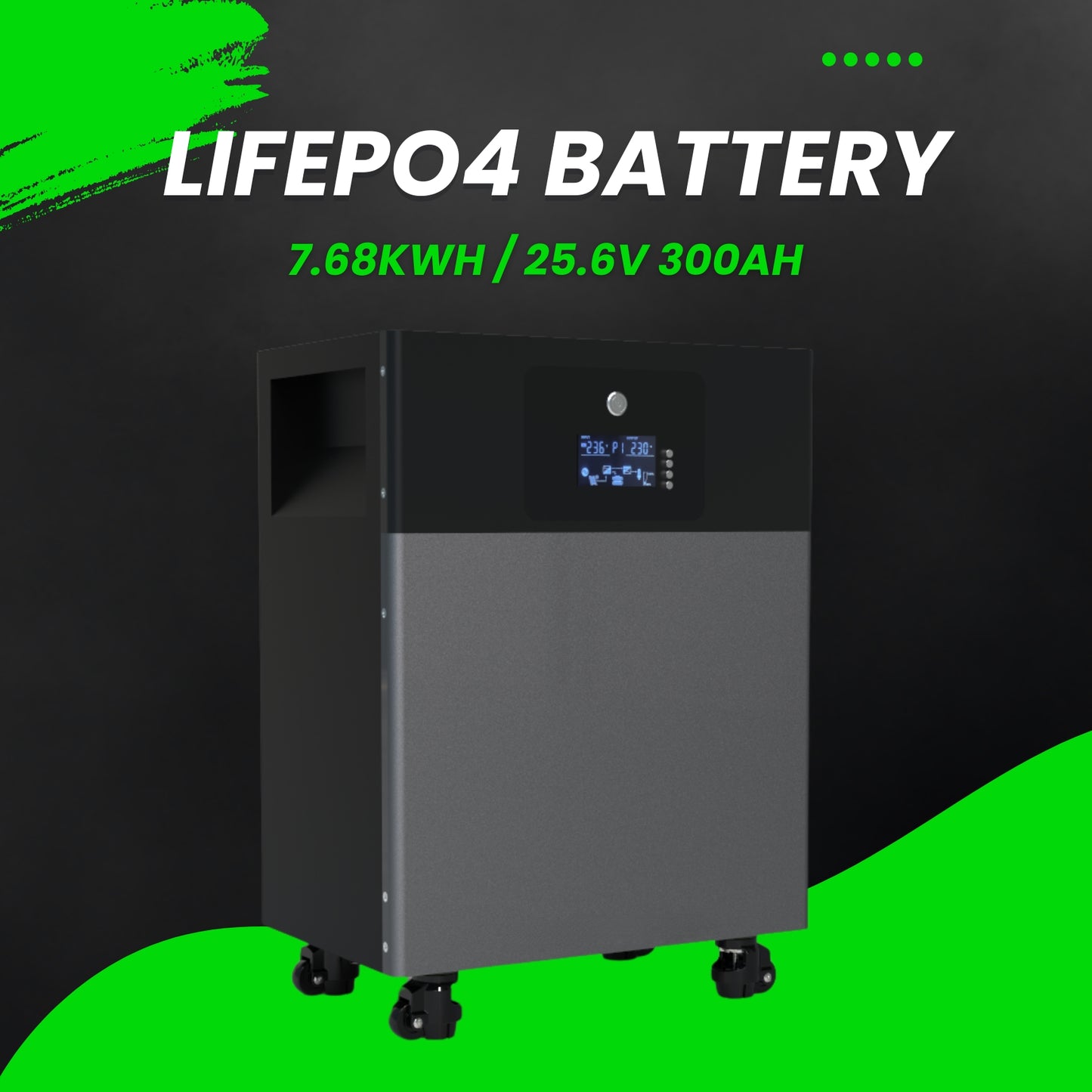
7.68kWh LiFePO4 Battery Pack 25.6V — Deep Cycle Solar Storage, 6000+ Cycles
7.68kWh LiFePO4 Battery Pack 25.6V — Deep Cycle Solar Storage, 6000+ Cycles
A 25.6 V bank at 300 Ah suits 24 V installations where a 48 V architecture is more than the system needs. It fits medium off-grid homes, and sites already standardised on 24 V inverters.
Where it fits best
- 24 V off-grid homes with moderate daily consumption
- Backup for a small household's essential circuits
- Sites already running 24 V inverters and charge controllers
Questions buyers ask
Why choose 25.6 V over 51.2 V?
If your inverter and existing equipment are 24 V, matching them avoids replacing the whole chain. The trade-off is higher current for the same power, so cable sizing matters more.
What is the usable capacity?
With an 80 % depth-of-discharge guideline, plan on roughly 6 kWh usable from the 7.68 kWh nominal figure. Staying inside that window is what delivers the quoted 6000-cycle life.
Technical specifications
| Rated Battery Voltage | 25.6 V |
|---|---|
| Energy | 7680 Wh |
| Nominal Capacity | 300 Ah |
| Combination Mode | 8S1P |
| Cycle Life | 6000 cycles @80% DOD |
| Monthly Self-discharge | 3 % |
| Charging Efficiency | 97 % |
| Discharge Efficiency | 98 % |
| Recommended Charging Voltage | 28.8 V |
| Recommended Charging Current | 150 A |
| Maximum Charging Voltage | 29.2 V |
| Maximum Charging Current | 200 A |
| Recommended Discharge Current | 150 A |
| Maximum Discharge Current | 200 A |
| Discharge Termination Voltage | 21.6 V |
| Charging Temperature Range | 0℃~45℃ |
| Discharge Temperature Range | -20℃~60℃ |
| Storage Temperature | 0℃~40℃ |
| Protection Class | IP30 |
| Shell Material | Case of metal |
| Communication | CAN/RS485/RS232 |
| Battery Size (W*D*H) | 395*262*570MM |
| Net Weight | 64 kg |
| Gross Weight | 70 kg |
| Package Size (W*D*H) | 653*476*427MM |
Explore more from IPV ESSA
Frequently Asked Questions
What is a LiFePO4 battery?
Lithium iron phosphate chemistry that offers long cycle life, thermal stability, and safe deep discharge compared with older battery types.
How long does it last?
LiFePO4 packs typically deliver thousands of charge cycles at 80% depth of discharge, which means years of daily use.
Can I expand capacity later?
Many IPV ESSA systems support parallel battery expansion; check the model manual for the maximum number of units.
Where should I install it?
In a ventilated, dry location away from direct heat and moisture, as with any electrical storage equipment.