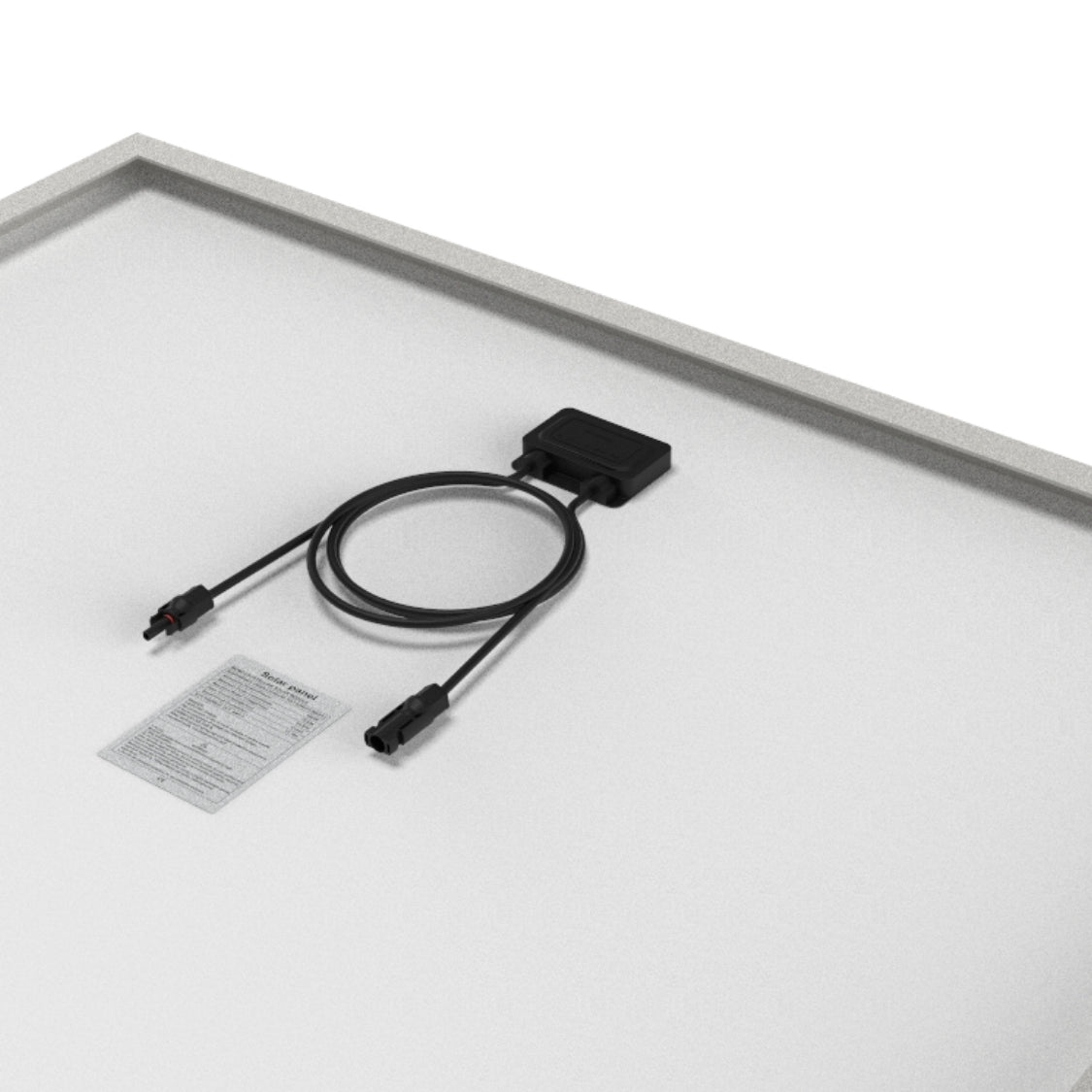
300W Monocrystalline Solar Panel PV Module for Home & Commercial Rooftop
300W Monocrystalline Solar Panel PV Module for Home & Commercial Rooftop
On a wider 1134 mm body, this 300 W module is the compact high-output option for rooftops where the available area is roughly square rather than a long narrow strip. Its 34.2 V maximum-power voltage keeps it firmly in the 24 V system camp.
Where it fits best
- Residential rooftops where a squarer footprint fits better
- 24 V hybrid systems working with a modest array area
- Replacing two smaller panels with a single higher-output unit
Questions buyers ask
How many do I need for a 3 kW array?
Ten modules gives 3 kW nameplate — a common size for a household aiming to cut daytime grid consumption substantially.
Does higher wattage mean it is less reliable?
No. The higher wattage comes from a larger active area, not from pushing the cells harder. Temperature coefficients stay in the normal range for monocrystalline modules.
Technical specifications
| Maximum Power (Pmax) | 300 W |
|---|---|
| Open Circuit Voltage (Voc) | 41.04 V |
| Short Circuit Current (Isc) | 9.3 A |
| Voltage at Pmax (Vmp) | 34.2 V |
| Current at Pmax (Imp) | 8.77 A |
| Module Efficiency | 20.51 % |
| Power Tolerance | 0, +4.99W |
| Maximum System Voltage | 700 V DC |
| Max Series Fuse Rating | 20 A |
| Module Type | 182M30034 |
| Solar Cells | Mono crystalline 182*121.2mm (6*10Pcs) |
| External Dimensions | 1290*1134*30mm |
| Weight | 15.11 kg |
| Front Glass | 3.2 mm tempered glass |
| Frame | Aluminum |
| Junction Box | IP67 |
| Output Cables | 90CM 4mm² Cable |
| Connector | MC4 Compatible |
| Mechanical Load | Front Side Max. 5400Pa, Rear Side Max. 2400Pa |
| Pmax Temperature Coefficient | -0.350%/°C |
| Voc Temperature Coefficient | -0.270%/°C |
| Isc Temperature Coefficient | +0.048%/°C |
| Package Dimensions | 1300*70*1149mm |
| Package Weight | 32.22 kg |
| Pieces per Package | 2 |
Explore more from IPV ESSA
- Shop all Solar Panels
- 360W Monocrystalline Solar Panel PV Module (1540×1134×30mm)
- 400W Monocrystalline Solar Panel PV Module (1720×1134×30mm)
Frequently Asked Questions
What is a monocrystalline solar panel?
A panel built from single-crystal silicon cells, giving higher efficiency and a smaller footprint than polycrystalline types.
Do panels work on cloudy days?
Yes, at reduced output — typically 10–50% of clear-sky levels depending on how thick the cloud cover is.
How long do solar panels last?
Quality modules commonly retain most of their output for 20–25 years thanks to tempered glass and aluminium frames.
Can I connect panels to a battery?
Panels feed an MPPT charge controller or hybrid inverter, which safely charges the connected battery bank.