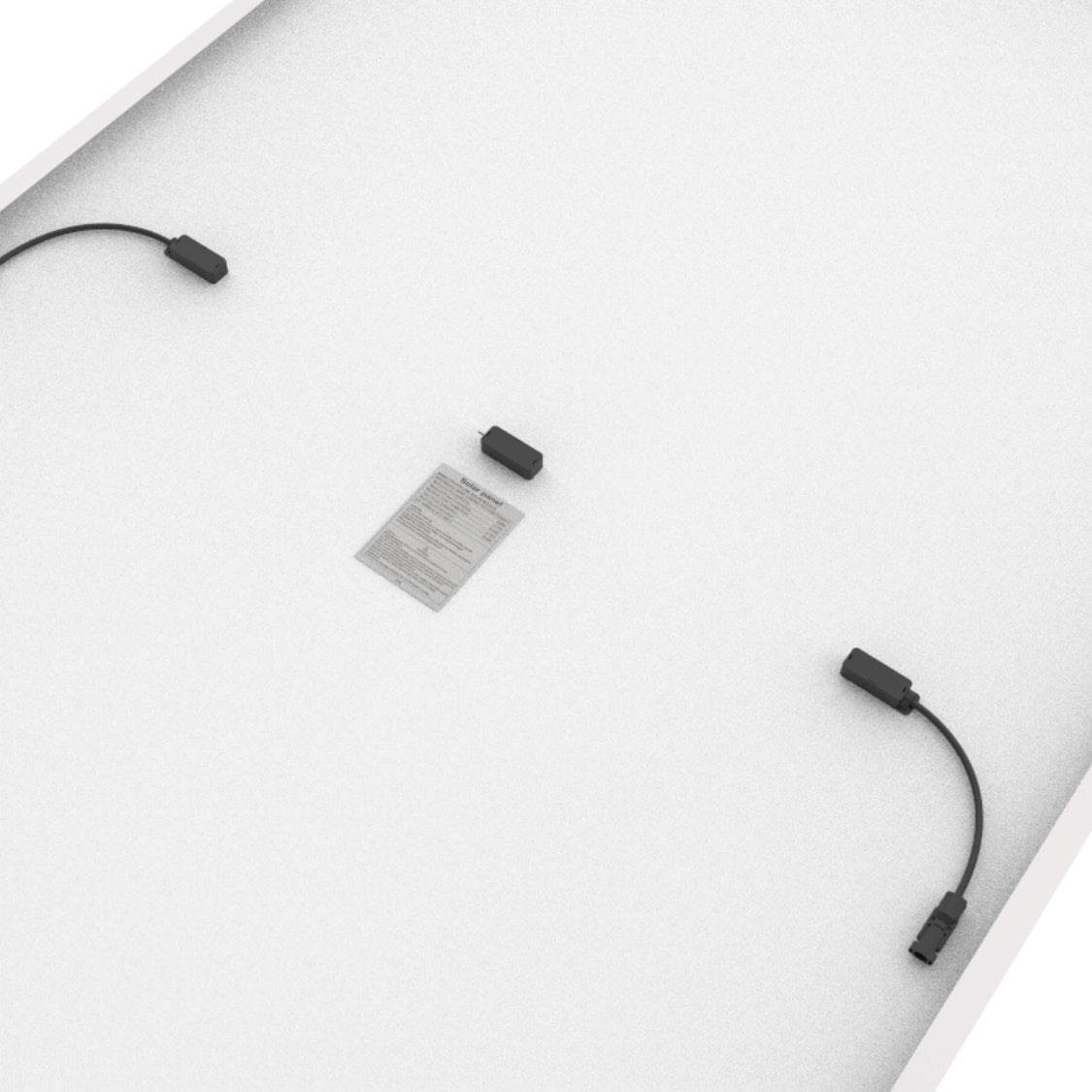
400W Monocrystalline Solar Panel PV Module for Home & Commercial Rooftop
400W Monocrystalline Solar Panel PV Module for Home & Commercial Rooftop
Four hundred watts from one module means fewer panels, fewer roof penetrations and less railing for the same array output. On a residential rooftop that translates directly into lower mounting hardware cost per installed kilowatt.
Technical specifications
| Maximum Power (Pmax) | 400 W |
|---|---|
| Open Circuit Voltage (Voc) | 36.84 V |
| Short Circuit Current (Isc) | 13.81 A |
| Voltage at Pmax (Vmp) | 30.7 V |
| Current at Pmax (Imp) | 13.03 A |
| Module Efficiency | 20.51 % |
| Power Tolerance | 0, +4.99W |
| Maximum System Voltage | 700 V DC |
| Max Series Fuse Rating | 20 A |
| Module Type | 182M40030 |
| Solar Cells | Mono crystalline 182*91mm (6*18Pcs) |
| External Dimensions | 1720*1134*30mm |
| Weight | 20.4 kg |
| Front Glass | 3.2 mm tempered glass |
| Frame | Aluminum |
| Junction Box | IP67 |
| Output Cables | 90CM 4mm² Cable |
| Connector | MC4 Compatible |
| Mechanical Load | Front Side Max. 5400Pa, Rear Side Max. 2400Pa |
| Pmax Temperature Coefficient | -0.350%/°C |
| Voc Temperature Coefficient | -0.270%/°C |
| Isc Temperature Coefficient | +0.048%/°C |
| Package Dimensions | 1735*70*1149mm |
| Package Weight | 43 kg |
| Pieces per Package | 2 |
Where it fits best
- Residential grid-tie arrays where roof space is limited
- Reducing panel count on an existing railing layout
- Commercial rooftops needing high watt density per square metre
Questions buyers ask
Is a heavier module harder to install?
At 20.4 kg it is a two-person lift. The mechanical load rating of 5400 Pa on the front side is unchanged, so the roof structure, not the glass, is usually the limiting factor.
What inverter pairing makes sense?
Match the string voltage to a string inverter or MPPT with adequate headroom, and have your installer confirm the cold-temperature open-circuit voltage stays inside the inverter's limit.
Explore more from IPV ESSA
- Shop all Solar Panels
- 450W Monocrystalline Solar Panel PV Module (1909×1134×30mm)
- 100W Monocrystalline Solar Panel PV Module (1030×460×25mm)
Frequently Asked Questions
What is a monocrystalline solar panel?
A panel built from single-crystal silicon cells, giving higher efficiency and a smaller footprint than polycrystalline types.
Do panels work on cloudy days?
Yes, at reduced output — typically 10–50% of clear-sky levels depending on how thick the cloud cover is.
How long do solar panels last?
Quality modules commonly retain most of their output for 20–25 years thanks to tempered glass and aluminium frames.
Can I connect panels to a battery?
Panels feed an MPPT charge controller or hybrid inverter, which safely charges the connected battery bank.